
Build Real Strength Without Gym Anxiety, Sensory Overload or Standing There Lost
An 8-week programme for nervous, anxious and neurodivergent people who want to get stronger, even if you've cancelled a gym membership in the car park before.
One-off payment · Instant download · 60-day money-back guarantee
What is the Sensory-Safe Strength System?
The Sensory-Safe Strength System is an 8-week digital strength training programme for nervous, anxious and neurodivergent adults, including autistic and ADHD people. It was created by Rhiannon Cooper, a CIMSPA-registered personal trainer who is autistic and ADHD herself. It combines zero-decision workout cards, sensory management strategies, word-for-word gym scripts and home workout alternatives. It costs £27 as an instant download and comes with a 60-day money-back guarantee.
Does This Sound Familiar?
You want to get stronger. You've been told exercise would help. You've watched other people walk into the gym like it's nothing and wondered what's wrong with you and why you just… can't.
It’s because gyms weren't designed for anxious or neurodivergent brains. And that's not your fault.
Maybe for you it's:
→ The sensory overload. Thick air, rubber smells, loud music, bright lights, and that horrible feeling of damp, sweaty clothes sticking to your skin.
→ The unwritten rules. What do I say? Can I ask to share this? How long can I use a machine? Is someone staring at me? Am I doing this wrong?
→ The fear of being watched in a big open room while you try to understand equipment you don't yet know how to use.
→ The executive function wall. Getting there is hard enough. Then you have to work out what to do, so you stand there awkwardly, then leave.
You've Probably Tried Everything the "Experts" Suggest
And every time it just felt like more proof that you were broken:
→ "Just put headphones on and zone out."
Then they slip off mid-exercise, you can't hear if someone's talking to you and what if you're breathing too loudly?! You spend the whole session on high alert.
→ "Go at off-peak times."
5am. 10pm. Sure… but your life doesn't work like that, and even when you went, you still didn't know what to do.
→ "Everyone's too focused on themselves to notice you."
Great, but that doesn't fix the noise, the unknown rules, expectations or your form.
→ "Just start on the treadmill."
Walking in place while screens flash at you and your heart rate climbs until you feel close to a meltdown? Hard pass.
→ "Build a home gym."
With what space, what money, and even then… where does the energy come from and how do you know what to do?
Then comes the cycle. Go once or twice, hate it, avoid it for weeks, feel guilty, try again… until you just stop.
Then I Had My Second-Ever Panic Attack… in a PureGym Car Park
I was sitting in my car with my app already open, trying to force myself to go inside. I thought about following someone confident in, but I had no idea what happened once I went through that first door. The unknowns were too much.
I drove home and cancelled my membership that night without ever setting foot in the building.
Not long after the day I got my autism and ADHD diagnosis. Things about me started making sense, and that's when I started asking a different question: what if the problem isn't me? What if nobody had ever built a gym system that actually works for brains like mine?
I spent the next year trying and testing things on myself. Then I decided to become a personal trainer, to help other people like me. Working with almost solely neurodivergent clients, I was able to refine my approach and confirm that barriers to movement often have nothing to do with a lack of motivation or discipline:
→ Sensory processing differences can make a typical, ordinary gym feel threatening, pushing your nervous system into fight-or-flight.
→ Executive function challenges make planning workouts, sequencing exercises and keeping a routine far harder without external structure.
→ Social anxiety about unwritten rules drains your energy and consumes your mind before you’ve even gone in.
→ Interoception differences make it hard to tell when you're pushing too hard, not hard enough, or need to stop. That takes any enjoyment out of the session, even if you’re ‘only on the treadmill’.
By removing decisions, reducing sensory triggers and giving myself crystal-clear structure, I was able to:
✔ Show up consistently, three times a week, without the dread-and-avoid cycle
✔ Know exactly what to do, without standing around feeling lost or anxious
✔ Handle sweat, noise and overstimulation with specific strategies
✔ Navigate gym etiquette with simple scripts that remove the guesswork
✔ Build real strength that makes everyday life easier and boosts my confidence
I've since turned it into a step-by-step system that 200+ people have used.
I call it the Sensory-Safe Strength System.
The 5 Missing Pieces Between "Dreading the Gym" and "Actually Going"
What nervous and neurodivergent people need, and generic gym programmes don't give you.
Absolute Clarity: Zero-Decision Workout Plans
What it is
Workout cards that tell you exactly what to do, in what order, with what weight and for how many reps.
Why it matters
When you're already spending huge amounts of energy managing sensory input and social situations, having to plan your own workout as well leads to burnout and avoidance.
Without it
You stand there overwhelmed, do random exercises with no plan, leave feeling you achieved nothing, and decide the gym "just isn't for you".
Sensory Survival: Practical Overstimulation Management
What it is
Specific, tested strategies for sweat, sound, smell, textures and visual overwhelm, not just "try headphones".
Why it matters
Sensory overload isn't weakness or fussiness. It's a neurological difference that makes gym environments genuinely overwhelming.
Without it
Every session feels like survival mode, your nervous system stays dysregulated, and you start to associate exercise with suffering instead of strength.
Social Scripts: Gym Etiquette Decoded
What it is
Word-for-word scripts for every gym interaction: asking to work in, declining help, handling small talk, and what to do if you get something wrong.
Why it matters
Not knowing the unwritten rules creates constant anxiety that pulls your focus away from your workout.
Without it
You avoid equipment you need, skip sessions because it's "too busy", and the social side becomes more exhausting than the exercise.
Routine Architecture: Making Consistency Automatic
What it is
Visual schedules, reminder systems and accommodation planning built for neurodivergent brains.
Why it matters
Motivation is unreliable for everyone, and even more so with anxiety, autism or ADHD. You need systems that work with your brain, not against it.
Without it
You rely on willpower, it fails, you blame yourself, and the "I just can't do this" story gets louder.
Body Awareness: Interoception Training
What it is
Guided practice for reading your body's signals: fatigue vs discomfort vs pain, hunger vs nausea, low energy vs sensory overload.
Why it matters
Many neurodivergent people find interoception difficult, which makes it hard to know when to push, when to rest, and when something's actually wrong.
Without it
You either push too hard and burn out or get hurt, or never push enough to feel progress, without ever knowing what "the right amount" feels like.
Your 8 Weeks, Step by Step
Feel safe in the space. Learn the equipment, test your sensory strategies and set your baseline routine.
✔ Machine familiarisation guide with visual guides and videos
✔ Sensory baseline assessment to identify your triggers and plan accommodations
✔ Your first structured routine, using just 5 machines so you're not overwhelmed by choice
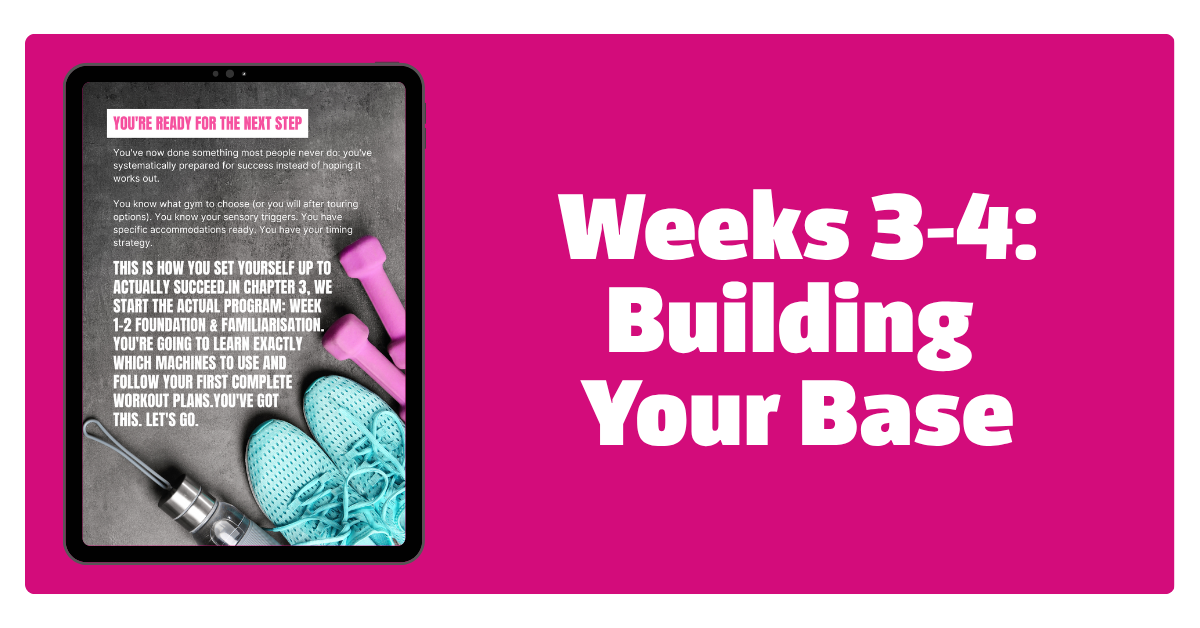
Turn familiarity into habit, so "gym day" becomes as automatic as "shopping day". Consistency over perfection.
✔ A schedule template that works with your energy and executive function
✔ Form-check guidance so you know you're doing it right, without needing to ask
✔ Progress tracking that shows you're getting stronger, even when it doesn't feel like it yet
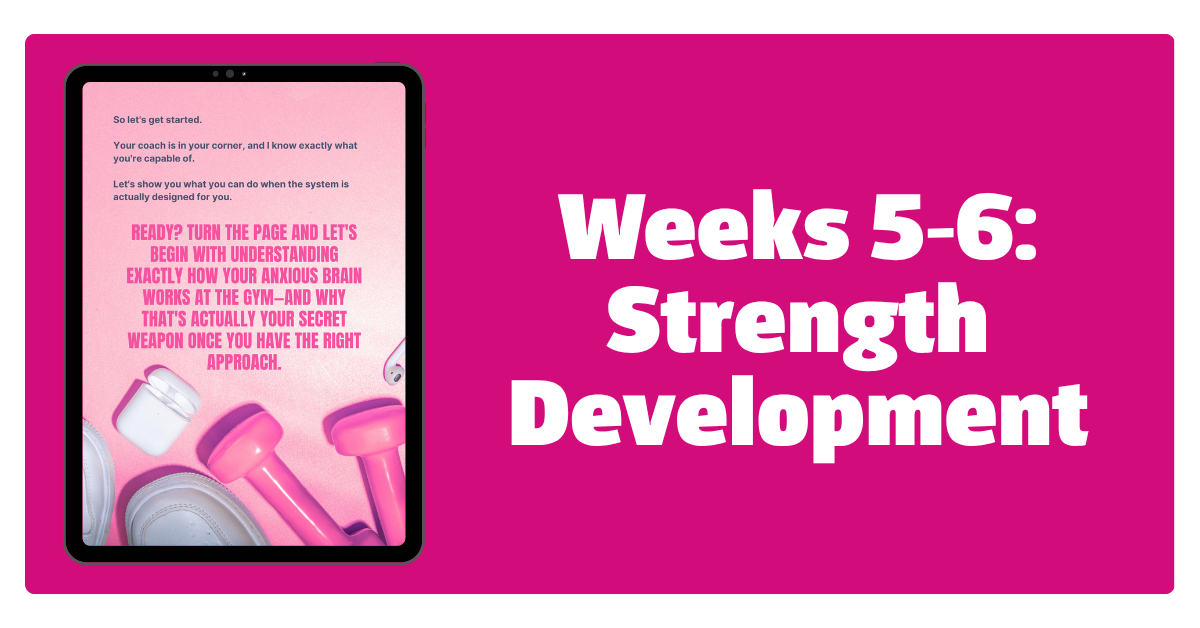
Weights that felt heavy in week 1 start to feel manageable, and everyday tasks like carrying shopping, opening jars and lifting things overhead get easier.
✔ Progressive overload guidance that tells you exactly when and how to increase weight
✔ Recovery guidance for telling "good tired" from "time to stop"
✔ Plateau strategies for when progress stalls, without having to work it out yourself
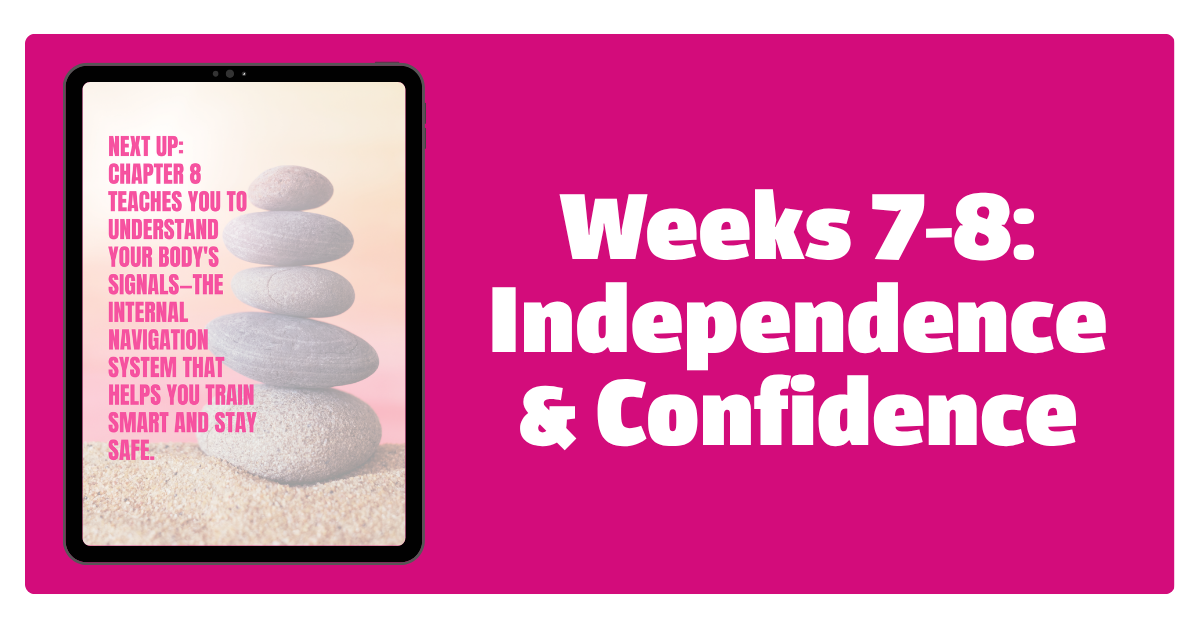
Walk in with purpose instead of dread, trust your own judgement, and plan what comes next.
✔ A framework for adapting workouts to your preferences and goals
✔ A long-term plan for staying consistent beyond the 8 weeks
✔ A troubleshooting guide for schedule changes, new gyms and unexpected challenges
What Changes When You Invest?
Before the Sensory Safe Strength System:
✗ Feeling paralysed with anxiety before every session, or avoiding the gym entirely
✗ Standing around unsure what to do, which machines to use, or whether you're doing it "right"
✗ Sensory overload from sweat, sounds, smells and crowds
✗ Starting and stopping, cancelling memberships, and feeling like everyone else can "just figure it out"
After the Sensory Safe Strength System:
✓ Walking in with your workout card ready, knowing exactly what you're doing today
✓ Following a clear plan that needs zero decisions
✓ Managing sensory input with strategies that work for your nervous system
✓ Having scripts for any social situation, and feeling confident using them
✓ Training consistently, getting stronger, and actually enjoying it
Everything You Get With The Sensory Safe Strength System
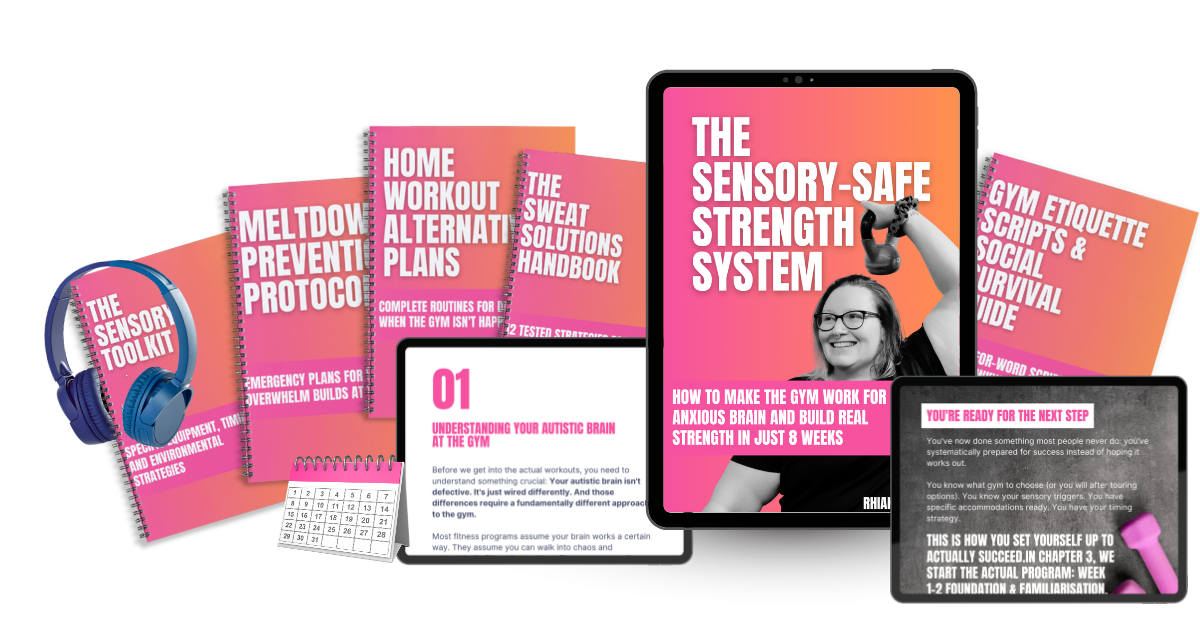
The Sensory-Safe Strength System: 8 progressive weeks that remove decision fatigue and build real, functional strength.
Plus 5 bonus guides:
✔ The Sweat Solutions Handbook: 12 strategies for managing sweat, damp clothes and that sticky feeling, including fabric recommendations, timing tips and emergency plans.
✔ Gym Etiquette Scripts & Social Survival Guide: Word-for-word scripts for every awkward gym interaction, plus a visual guide to the unwritten rules.
✔ The Sensory Toolkit: Equipment and clothing recommendations, timing strategies and environmental adjustments that make the gym more manageable.
✔ Meltdown Prevention Protocol: A step-by-step plan for when overwhelm starts building, including exit strategies, regulation techniques and how to recover afterwards.
✔ Home Workout Alternative Plans: Complete bodyweight and minimal-equipment routines for days when the gym isn't happening, or if you'd rather train at home.
£27
One-off payment · Instant download · 60-day money-back guarantee
What People Are Saying
Real messages from people who were exactly where you are now.
All names are hidden to protect the privacy of my clients and community.
From people using the Sensory-Safe Strength System
I bought your sensory safe guide yesterday and it made me so happy reading it that someone knows exactly what I need to help me make a change in my health and life. I read the whole guide and plan to start this week when I can.
This system has changed my entire experience at the gym! So so so good. I just feel more confident and even tried the rowing machine for the first time!
Thanks to you, this week I've signed up for the gym and I'm going in for my first session this week! Thank you!
100% recommended! This has helped me so much to find my own routine that works for me. Thank you!
I've purchased your sensory strength guide. I'm a researcher so I read all of it and can't wait to start it next week!
From clients and the community
Rhiannon I just have to tell you this! I asked a girl how many sets she had left!! And she was still using the machine and said she was going to be a while so I went into the main section and used the one there instead! I did itttt
I was still too scared. I wanted to but I couldn't quite get there. Finding Rhiannon just pushed me the last few steps and even though it's very early days I'm actually looking forward to the future for the first time in a long time.
I've had so much of professionals not listening or understanding in other areas of life. I'm sure many other neurodivergent people will relate to how exhausting and upsetting it is. So pleased I am having a brilliant and validating experience with exercise after finding you!
This morning I walked into the gym and did a workout for the first time ever, and it's thanks to you.
Rhiannon's advice and support has absolutely changed my life for one!
Try It for 60 Days, Risk-Free
If the Sensory-Safe Strength System doesn't work for you within 60 days of purchase, email me for a full refund. You don't need to give a reason or prove you tried it. If it's not right, it's not right.
Your Questions, Answered
Who is the Sensory-Safe Strength System for?
It's for nervous, anxious and neurodivergent adults who want to build strength but find gyms overwhelming, including autistic and ADHD people and anyone with gym anxiety. You don't need a diagnosis to use it. If gyms feel like too much, it's built for you.
Is there a gym programme specifically for autistic people?
Yes. The Sensory-Safe Strength System by Rhiannon Cooper at Not So Typical Fitness is an 8-week programme designed with autistic people in mind, covering sensory accommodations, social scripts and structured workouts that remove decision-making pressure.
What fitness programmes work for people with ADHD?
The Sensory-Safe Strength System is designed for ADHD brains as well as autism and anxiety. It uses zero-decision workout cards to avoid decision paralysis, structured progressive routines to support consistency, and reminder systems that don't rely on motivation.
Who created the Sensory-Safe Strength System?
It was created by Rhiannon Cooper, a CIMSPA-registered personal trainer and TEDx speaker who coaches neurodivergent clients online. Rhiannon is late-diagnosed autistic and ADHD, and built the programme from her own experience of gym anxiety and her work with neurodivergent clients.
I'm not training yet. Will this work for me?
Yes. It works for complete beginners and for people who've started and stopped many times. You don't need any experience, just a willingness to try a system designed for brains like yours.
What if I don't have a gym membership?
You can do the full 8 weeks at home. Bonus 5 includes complete home workout plans using minimal equipment, such as resistance bands and dumbbells. If you're completely new to strength training, my 80 Bodyweight Movements Guide (£9) is a gentle place to start, with no equipment needed.
Will this work if I have chronic pain or physical limitations?
In most cases, yes. Every exercise includes modifications, and the body awareness training helps you tell "challenging but safe" from "stop now". I've worked with clients who have fibromyalgia, EDS, POTS and chronic fatigue. If you have a health condition, check with your doctor or physio before starting.
How does the 60-day guarantee work?
If the Sensory-Safe Strength System doesn't work for you within 60 days of purchase, email me for a full refund. You don't need to prove you tried it or give a reason. If you'd like help using it first, get in touch, because a quick email often solves the problem.
How do I request a refund?
Email rhiannon@notsotypicalfitness.co.uk with "Refund Request" in the subject line, and include your order number if you have it. Refunds are processed within 5–7 working days.
What if I want more support?
If you'd like personalised programming and regular check-ins, my online coaching is £199 a month and built around your energy, sensory needs and executive function. Book a free discovery call to see if it's the right fit.
About Rhiannon
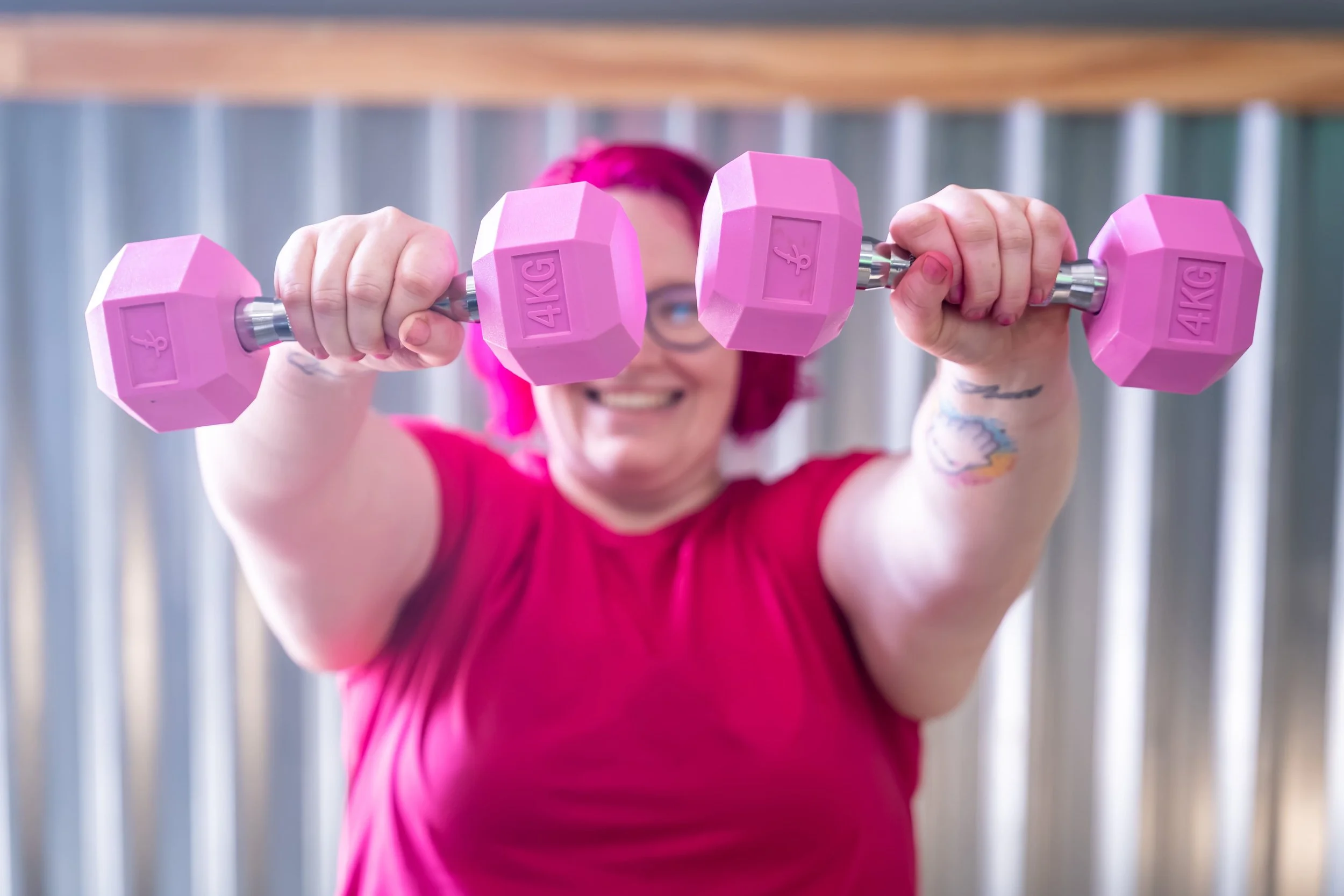
I'm Rhiannon Cooper, a CIMSPA-registered personal trainer, TEDx speaker and competitive strongwoman, and I'm late-diagnosed autistic and ADHD. I know what it's like to have a panic attack in a gym car park. That's exactly why I build fitness around how our brains actually work, not around "just push through it".
I now coach nervous, anxious and neurodivergent adults online, and my work has been featured in The Guardian, FitPro and ITV.
Not So Typical Fitness · Online Coaching · CIMSPA-registered
About · Online Coaching · Contact · Privacy Policy · Terms & Conditions
Medical disclaimer: This programme is not a substitute for professional medical advice. Please check with your doctor before starting any new exercise programme. Individual results vary depending on your starting point, health conditions and consistency.
© 2026 Not So Typical Fitness