
Online Strength Training for Sensory Sensitivities: What Actually Works
If you have sensory sensitivities; whether you're autistic, have ADHD, or experience sensory processing differences; finding a strength training programme that actually works for your body and brain is genuinely hard.
Most programmes are built for people who can tune out a busy gym, power through discomfort without shutting down, and follow instructions delivered in a fast-paced, high-stimulation format. If that's not you, you're not failing at fitness. You're just using a tool that wasn't designed for you.
So what should an online strength training programme actually look like if it's built for sensory sensitivities? Here's what matters.
What "sensory-friendly" actually means in a fitness context
Sensory sensitivities affect how your nervous system processes input; noise, texture, pressure, temperature, visual clutter, unexpected touch. In a fitness context, this can mean:
Certain exercises feel physically unbearable (not just hard; genuinely aversive)
Busy, unpredictable environments trigger shutdown or meltdown
Fluorescent lighting, loud music, or mirrored walls make gym spaces inaccessible
Instructions delivered verbally, quickly, or in large chunks are difficult to process
Inconsistency in a programme creates anxiety that overrides motivation
A programme built for sensory sensitivities addresses these directly; not as afterthoughts or "modifications," but as the foundation of how it's designed.
What to look for in an online strength training programme
1. Exercises you can actually do in your own space
The single biggest advantage of online training for people with sensory sensitivities is environment control. You choose the lighting, the noise level, the temperature, and the clothing. A good programme is designed to work in that context; not a gym programme awkwardly adapted for home.
2. Clear, low-pressure instructions
Instructions should be written (or recorded) in a calm, direct style. No countdown timers barking at you, no over-enthusiastic coaching energy, no assumption that you'll thrive on urgency. Step-by-step guidance that you can pause, re-read, or return to without losing your place.
3. Flexibility without chaos
People with sensory sensitivities often do better with structure; but rigid programmes that fall apart the moment you miss a session create more anxiety than they solve. The sweet spot is a programme with a clear framework that still allows you to adapt on difficult days without starting over.
4. No requirement to mask
Some fitness programmes are built on motivation tactics that require you to perform enthusiasm, push through pain signals, or override your body's feedback. That's the opposite of what works for autistic and sensory-sensitive people. A good programme teaches you to listen to your nervous system, not ignore it.
5. Built by someone who actually understands
There's a difference between a programme with a "sensory modifications" section bolted on at the end, and one built from the ground up by a trainer who is neurodivergent themselves. The latter is rarer; but it exists.
The Sensory-Safe Strength System
The Sensory-Safe Strength System is an 8-week online strength training programme designed specifically for people with sensory sensitivities, autism, ADHD, and anxiety.
It was created by Rhi, an AuDHD personal trainer and CIMSPA-registered fitness professional; not someone who has added "neurodivergent-friendly" to their marketing, but someone who has built every element of this programme around how neurodivergent brains actually work.
What makes it different:
Zero-Decision Workout Cards that tell you exactly what to do, when, and how; no executive function required
12 sensory accommodations most trainers never mention (prevent meltdowns before they start)
Every unwritten gym rule decoded so you never avoid equipment because you don't know if you're "allowed"
Progressive strength protocols for anxious brains, to build real muscle without burning out
Meltdown Prevention Protocol: recognise warning signs and exit gracefully before shutdown hits
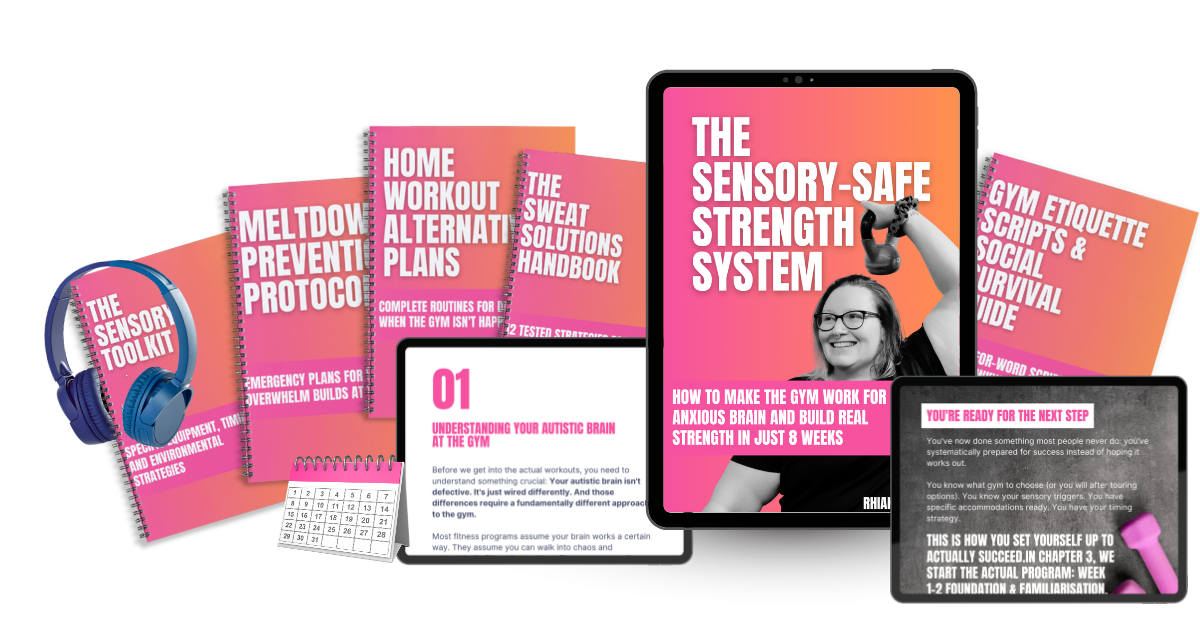
It's available for £27 with a 60-day money-back guarantee.
Frequently asked questions
Can I do this programme if I'm a complete beginner? Yes. The Sensory-Safe Strength System is designed to be accessible regardless of fitness history. The focus is on building a sustainable relationship with movement; not achieving a specific fitness level before you're "allowed" to start.
Do I need a gym or special equipment? No gym needed. The programme uses dumbbells, which you can use at home. It's designed specifically for home environments where you have full control over sensory input.
Is this programme suitable for autistic adults? Yes; it was built with autistic and ADHD adults as the primary audience. The structure, language, and approach reflect how neurodivergent brains process information and experience movement.
What if the programme doesn't work for me? There's a 60-day money-back guarantee, so you can try it without financial risk.
Is this different from just finding a "beginner" programme online? Yes. Most beginner programmes assume a neurotypical nervous system. The Sensory-Safe Strength System is designed around sensory processing differences from the ground up; the pacing, the instructions, the exercise selection, and the structure are all built with that in mind.
