
Upper Body Dumbbell Workout: Complete Home Guide (With Sensory-Friendly Options)
Building a strong, defined upper body doesn't require a gym membership or expensive equipment. With just a pair of dumbbells and some floor space, you can develop your chest, back, shoulders, and arms effectively at home.
This guide covers six upper body dumbbell exercises, how to structure your sessions, and how to make progress over time, with sensory-friendly adaptations woven throughout for anyone who finds standard fitness advice doesn't quite fit.
I'm Rhiannon, a CIMSPA-registered personal trainer specialising in neuroinclusive fitness, and I'm AuDHD myself. That informs everything I write and teach, including this guide.
Equipment You Need
Dumbbells: For beginners, a set ranging from around 1-6kg is affordable and provides a good starting point (like these from Amazon). However, weight selection is highly individual and depends on your current strength levels. What feels light for one person might be challenging for another, and that's completely normal.
For long-term progression, consider adjustable dumbbells (I recommend this set on Amazon and if you do purchase them (or any other of my Amazon recommendations) I might get a small payment through my affiliate scheme which helps fund the website!). These allow you to increase weight as you get stronger without buying multiple sets.
Space: Enough room to extend your arms fully in all directions while standing or lying down.
Not sure if you're ready for dumbbells? Start with my 80 bodyweight exercises for home movement library to build foundational strength first.
How to Structure This Workout
Starting point: Perform 3 sets of 8-12 reps for each exercise, resting 60-90 seconds between sets.
Total time: This full workout takes approximately 45–55 minutes including rest periods. If you're short on time, you can split it across two shorter sessions; push movements (shoulder press, floor press, tricep extension) one day, pull movements (bent-over row, bicep curl, reverse fly) the next.
Warm Up Before You Start
Before starting, spend 5 minutes raising your heart rate and loosening your joints. This doesn't need to be complicated: arm circles, shoulder rolls, bodyweight squats, and a brisk walk or light jog on the spot all work. Warming up reduces injury risk and improves how the exercises feel; which matters even more if you have sensory sensitivities that make sudden physical exertion uncomfortable.
Choosing Your Starting Weight
Pick a weight where you can complete 8 reps with good form, but the last 2-3 reps feel challenging. If you can easily do 12 reps and could keep going, the weight is too light. If you can't reach 8 reps with proper form, it's too heavy.
It's better to start lighter than you think you need as you can always increase the weight next session.
Progressive Overload: How to Keep Making Progress
Your muscles grow stronger by adapting to increasing demands. If you do the same workout with the same weight forever, your progress will stall. Progressive overload means gradually increasing the challenge over time.
How to progress:
Add reps first (easiest method)
Week 1: You manage 8 reps per set
Week 2: Aim for 9 reps per set
Week 3: Push for 10 reps per set
Continue until you can do 12 reps for all 3 sets with good form
Then increase weight
Once you hit 3 sets of 12 reps comfortably, increase the weight by 1-2kg
You'll likely drop back down to 8-9 reps; that's normal
Repeat the process of building back up to 12 reps
Alternative progression methods:
Add a set: Go from 3 sets to 4 sets (increases total volume)
Slow down the tempo: Take 3-4 seconds to lower the weight (increases time under tension)
Reduce rest time: Drop from 90 seconds to 60 seconds between sets (increases intensity)
Track your workouts: Write down the weight, sets, and reps for each exercise. This removes guesswork and lets you see your progress over weeks and months.
Progressive overload doesn't mean adding weight every single workout; it means consistent, gradual increases over time. Even adding one extra rep per week is progress.
The 6 Exercises
1. Dumbbell Shoulder Press (Shoulders & Triceps)
Targets: Shoulders (deltoids), triceps
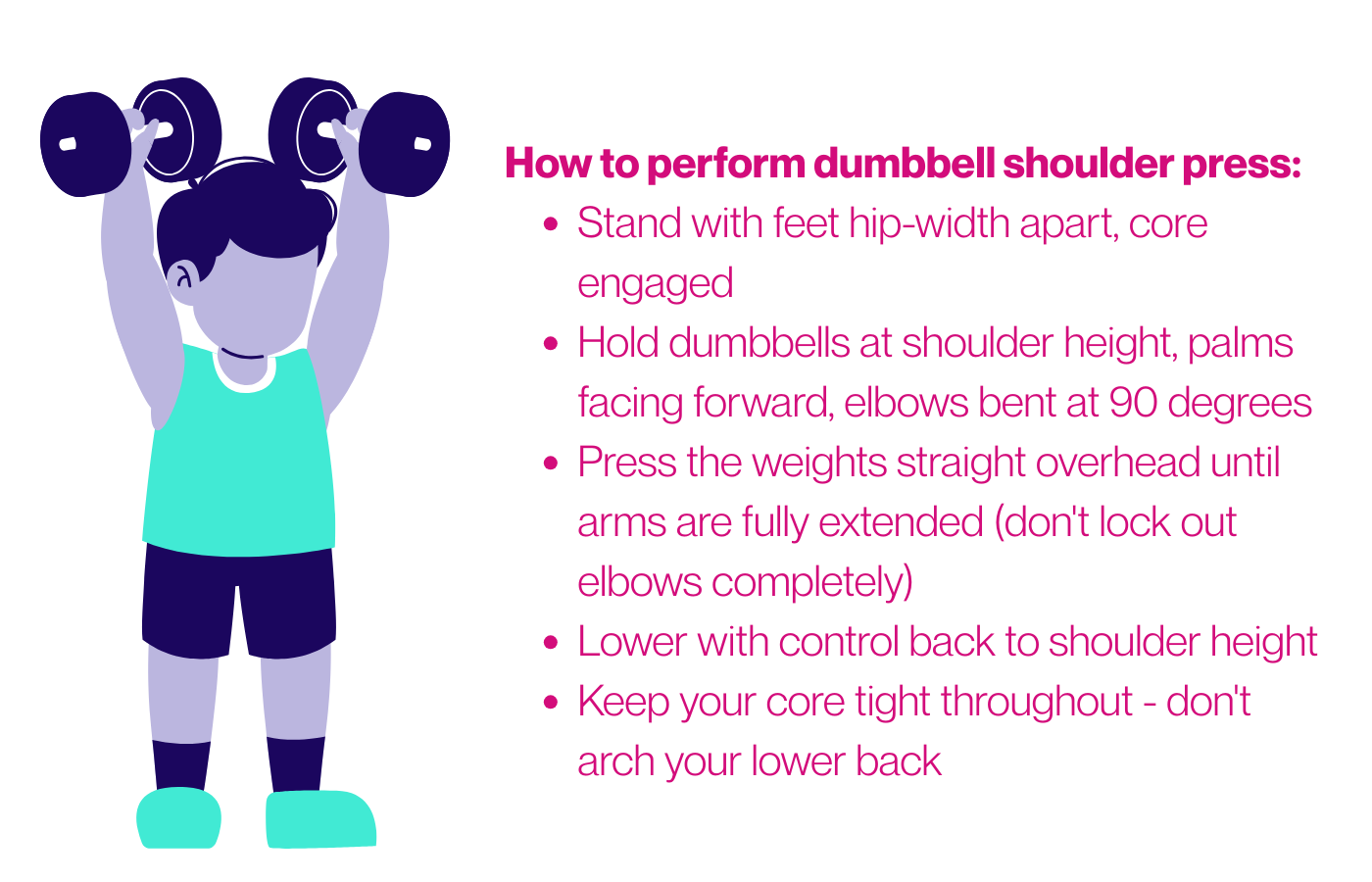
Safety note: If you feel strain in your lower back, you're likely overextending. Reduce the weight or check your core engagement.
2. Dumbbell Bent-Over Row (Back & Biceps)
Targets: Back (lats, rhomboids), biceps
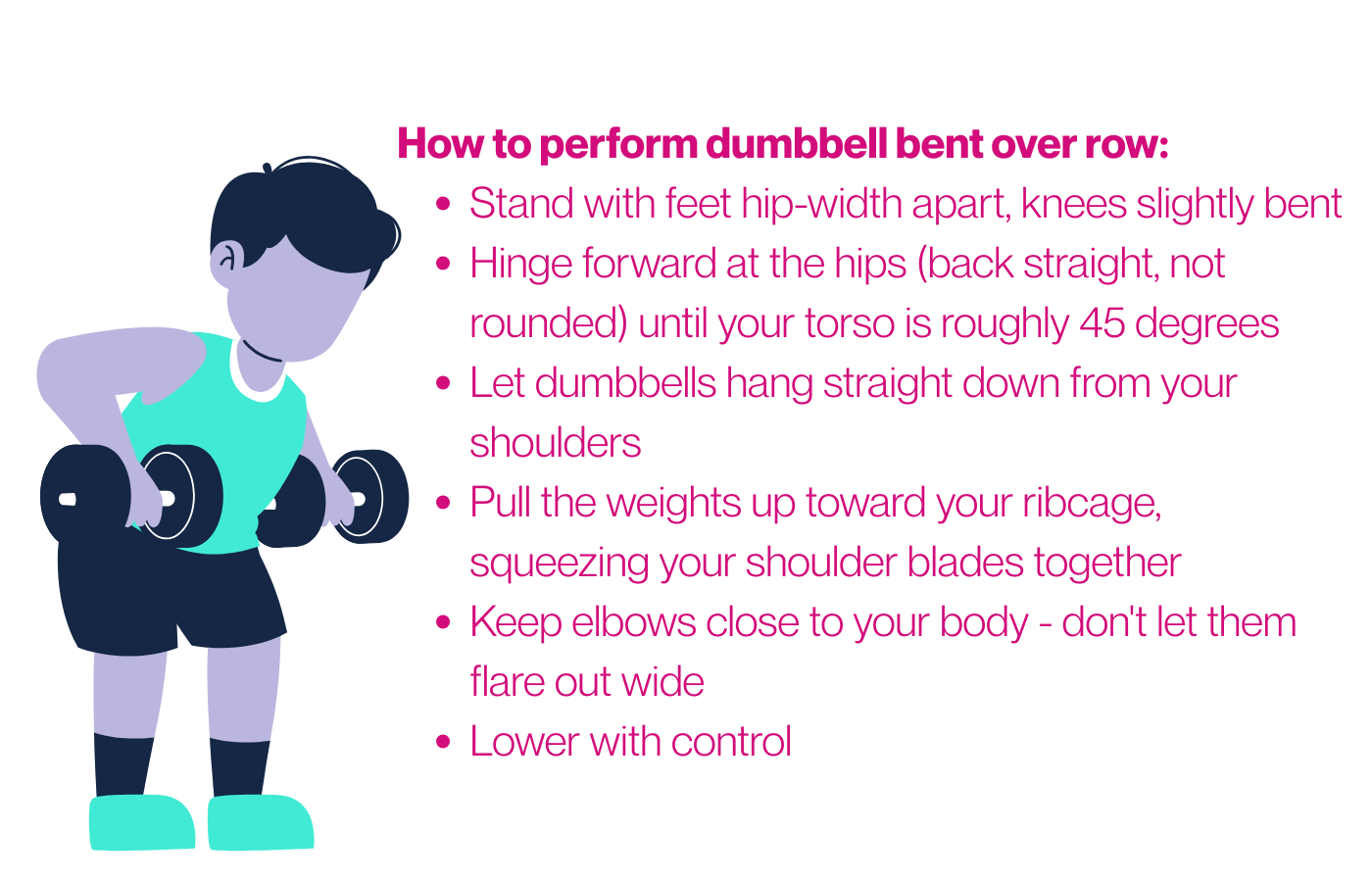
Safety note: Maintain a neutral spine throughout. If your lower back rounds, reduce the forward lean or decrease weight.
ND tip: If holding the hinge position feels unstable or uncomfortable, place your free hand on a chair or low surface for support. This reduces the balance demand and lets you focus on the pulling movement.
3. Dumbbell Floor Press (Chest & Triceps)
Targets: Chest (pectorals), triceps, front shoulders
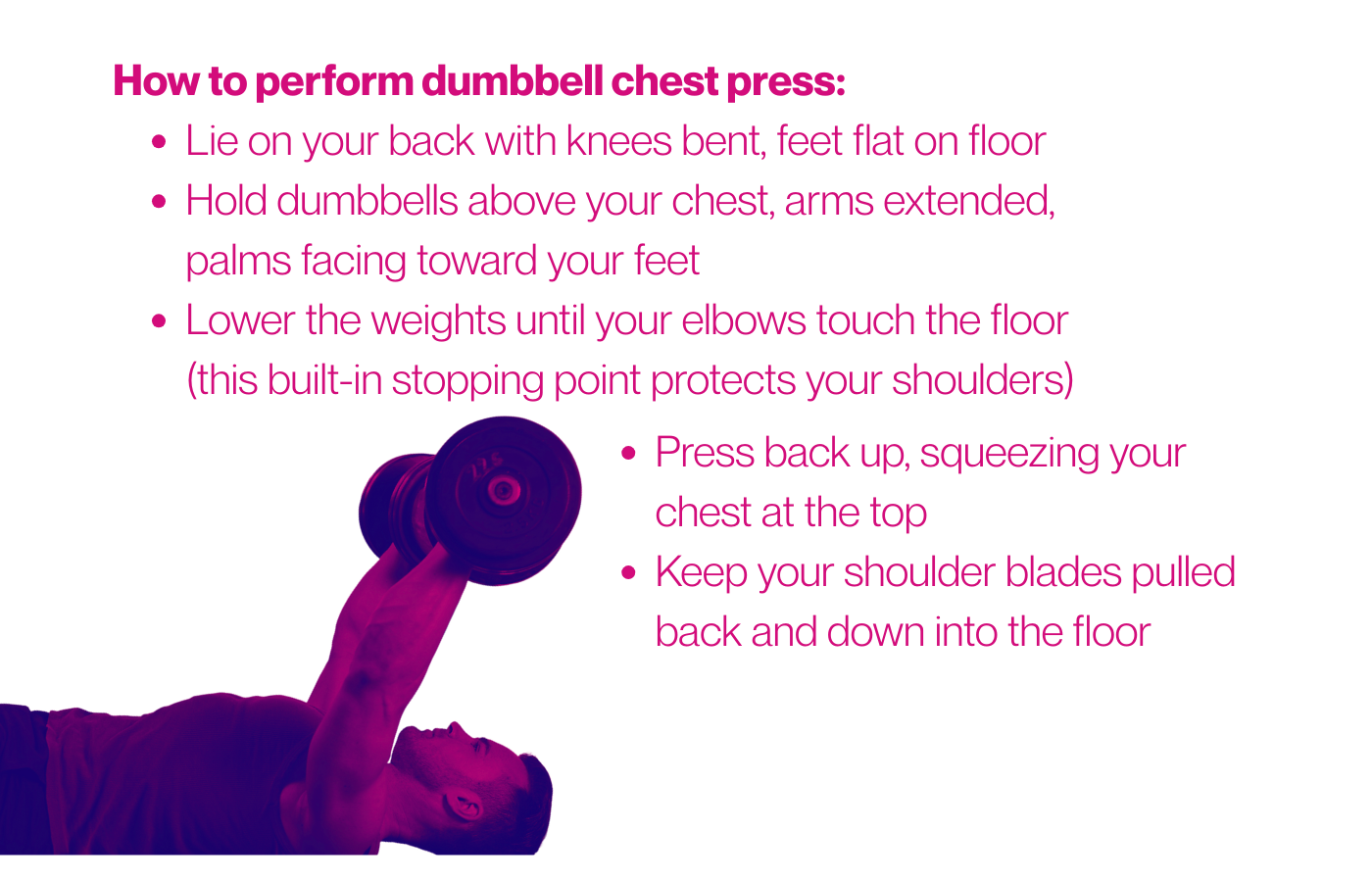
Safety note: Don't bounce your elbows off the floor - touch lightly and press back up with control.
Sensory adaptation: If lying on a hard floor is uncomfortable, a folded blanket or yoga mat under your back and arms is a completely valid modification; it doesn't change the exercise.
4. Dumbbell Bicep Curl (Biceps)
Targets: Biceps
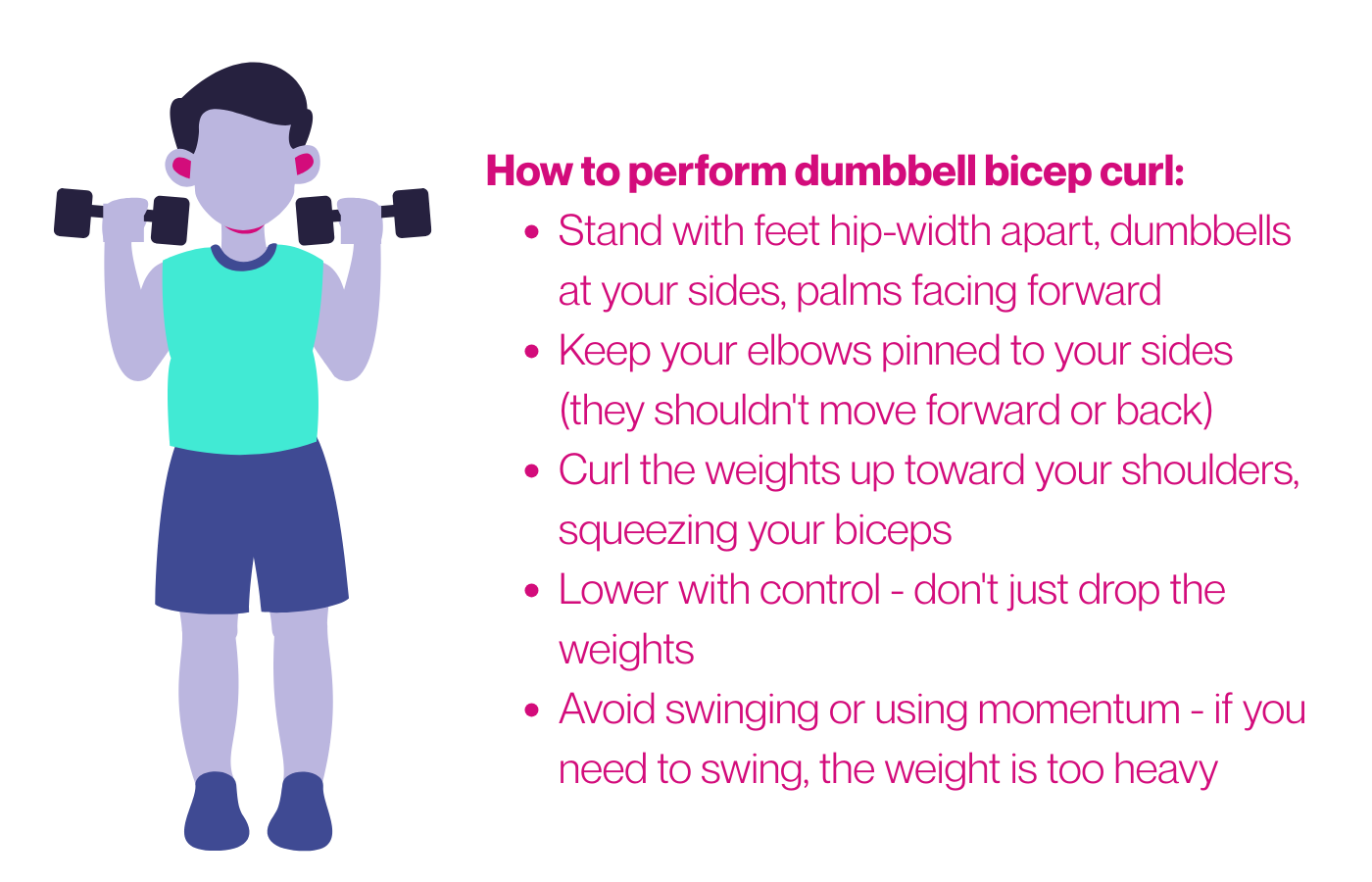
Safety note: Keep your wrists neutral (straight line from knuckles to forearm). Don't bend them back as you curl.
ND tip: If counting reps feels distracting or difficult, try timing your sets (30–40 seconds of controlled curls) instead. Same stimulus, less cognitive load.
5. Dumbbell Reverse Fly (Rear Shoulders & Upper Back)
Targets: Rear shoulders (posterior deltoids), upper back
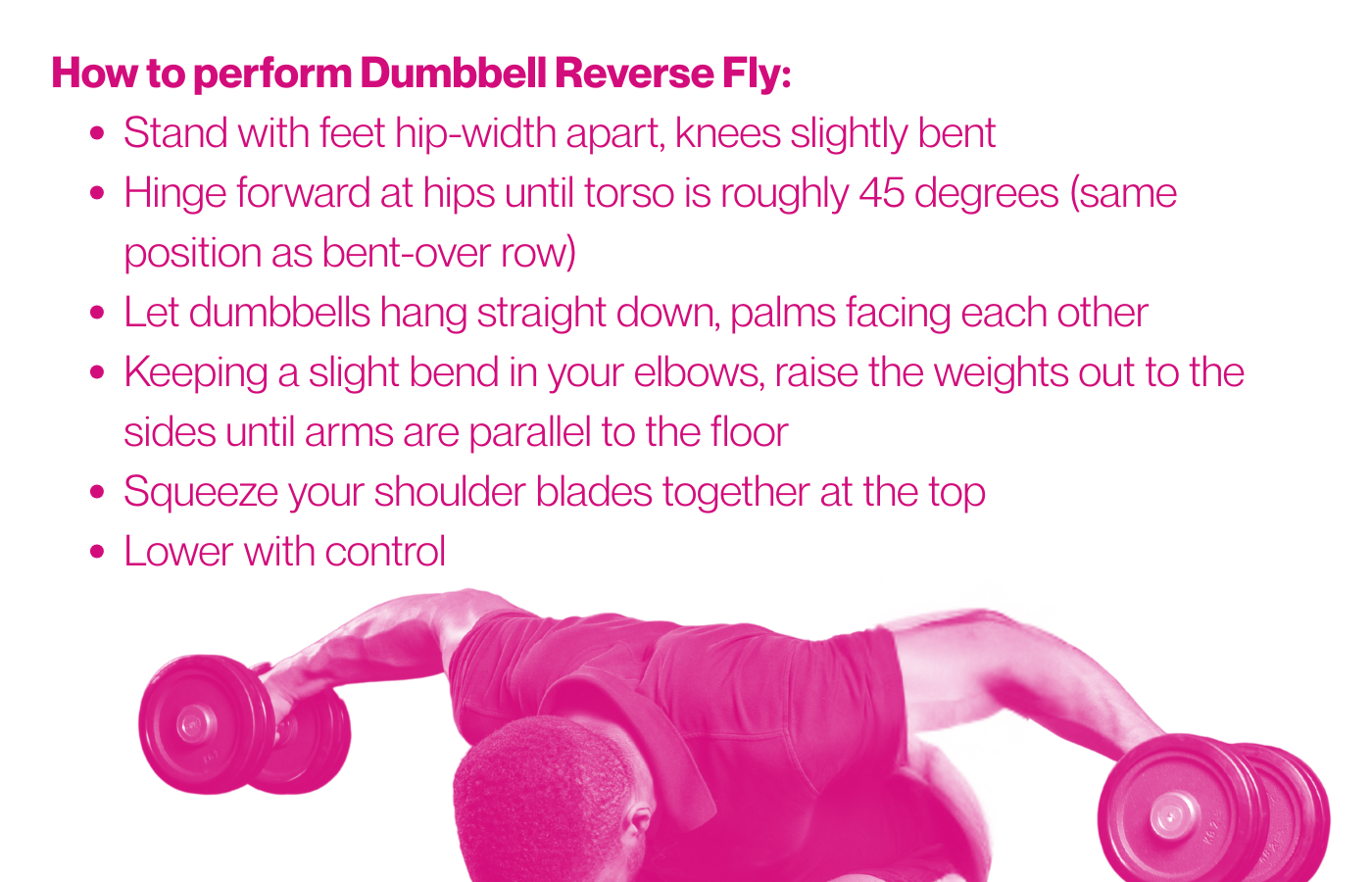
Safety note: This should be felt in the back of your shoulders and upper back. If you feel it in your lower back, reduce your forward lean or decrease weight. Use lighter weight than your other exercises - this is a smaller muscle group.
6. Dumbbell Overhead Tricep Extension (Triceps)
Targets: Triceps
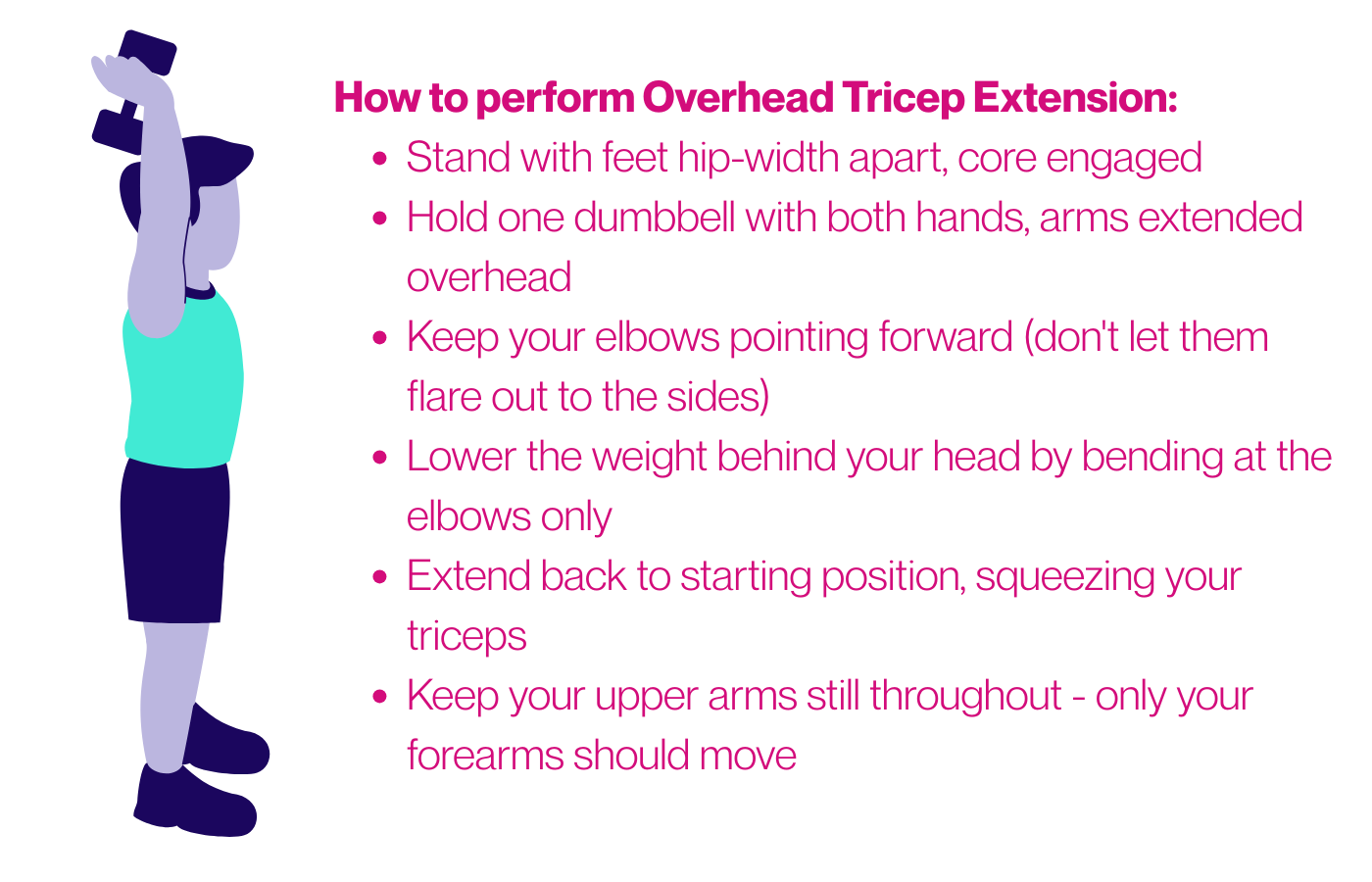
Safety note: If you feel shoulder discomfort, this exercise might not suit your mobility. Skip it or substitute with tricep kickbacks.
| Exercise | Primary Muscles | Sets x Reps |
|---|---|---|
| Shoulder Press | Shoulders, Triceps | 3 x 8-12 |
| Bent-Over Row | Back, Biceps | 3 x 8-12 |
| Floor Press | Chest, Triceps | 3 x 8-12 |
| Bicep Curl | Biceps | 3 x 8-12 |
| Reverse Fly | Rear Shoulders, Upper Back | 3 x 8-12 |
| Overhead Tricep Extension | Triceps | 3 x 8-12 |
New to strength training entirely? The Sensory-Safe Strength System is an 8-week programme built specifically for neurodivergent people, structured to reduce overwhelm, with adaptations built in from the start, not bolted on at the end. It's £27 with a 60-day money-back guarantee.
How Often Should You Train Upper Body?
Minimum effective dose: 2 sessions per week with at least 48 hours rest between upper body workouts. This allows your muscles time to recover and grow stronger.
For faster progress: 3 sessions per week, spreading them evenly (e.g., Monday, Wednesday, Friday).
What to do on other days:
Rest completely (especially important when starting out)
Train lower body or do cardio
Light movement like walking or stretching
Your muscles don't grow during the workout; they grow during recovery. More isn't always better. If you're still sore from your last session, add an extra rest day.
Frequently Asked Questions
Q: What weight dumbbells should you use for upper body workouts? For beginners, 1–6kg is a good starting point. Pick a weight where you can complete 8 reps with good form but the last 2–3 reps feel challenging. If you can breeze through 12 reps, go heavier. If you can't reach 8 with good form, go lighter. For long-term progression, adjustable dumbbells mean you won't need to keep buying new sets.
Q: How many sets and reps should you do for upper body dumbbell exercises? Start with 3 sets of 8–12 reps per exercise, resting 60–90 seconds between sets. Once you can complete 3 sets of 12 reps comfortably, increase the weight by 1–2kg and build back up from 8 reps again.
Q: How often should you train upper body per week? Twice a week is the minimum effective dose, with at least 48 hours between sessions. Three times a week (e.g. Monday, Wednesday, Friday) works well if you want faster progress. Your muscles grow during recovery, not during the workout — more isn't always better.
Q: How long does this workout take? Approximately 45–55 minutes including rest periods. Short on time? Split it into two sessions: push movements (shoulder press, floor press, tricep extension) one day, pull movements (bent-over row, bicep curl, reverse fly) the next.
Q: What is progressive overload and how do I apply it? Progressive overload means gradually increasing the challenge so your muscles keep adapting. The simplest method: add one rep per week until you hit 3 sets of 12, then increase the weight by 1–2kg. You can also add a set, slow down the lowering phase to 3–4 seconds, or reduce rest time between sets.
Q: What are the best upper body dumbbell exercises? The six exercises in this guide cover all major upper body muscle groups: shoulder press (shoulders and triceps), bent-over row (back and biceps), floor press (chest and triceps), bicep curl (biceps), reverse fly (rear shoulders and upper back), and overhead tricep extension (triceps).
Q: What if standard workout routines don't work for me? That's not a willpower problem. Executive dysfunction, sensory sensitivities, and interoception differences are real barriers that standard fitness advice doesn't account for. Adaptations like timing sets instead of counting reps, or using a folded blanket under your back for floor exercises, can make a meaningful difference — and that's exactly what this guide is designed around.
When Standard Fitness Advice Doesn't Work for You
You might have noticed that knowing what to do and actually doing it consistently are two completely different challenges.
If you find yourself:
Struggling to start workouts even when you know exactly what's on the plan
Feeling overwhelmed by gym environments or unable to predict when it'll be quiet
Finding routines fall apart despite genuine intention to stick to them
Experiencing sensory discomfort during workouts, certain movements feel "wrong," textures bother you, or you feel overstimulated afterwards
...that's not a willpower problem. It's a mismatch between how fitness is typically structured and how your brain actually works.
Executive dysfunction, sensory sensitivities, and interoception differences (difficulty reading your body's signals) are real barriers that standard fitness advice ignores entirely. The exercises themselves aren't the issue, it's the environment, the structure, and the assumption that everyone processes and motivates in the same way.
I work specifically with neurodivergent people - and I'm AuDHD myself - so I understand these barriers from the inside. The adaptations I use aren't workarounds; they're a better way to build fitness for a lot of people, neurodivergent or not.
Quick Reference: Upper Body Dumbbell Workout
These 6 exercises target all major upper body muscle groups
Start with 1-6kg dumbbells or choose weight based on your individual strength
Focus on proper form before increasing weight
Progress by adding weight, reps, or sets every 2-4 weeks
Train upper body 2-3 times per week with rest days between
Consistency beats perfection. Start with what you can manage, focus on form, and progress gradually.
Want to know more about my approach? Learn about my story and why I specialise in neuroinclusive fitness.
Continue Your Fitness Journey
- Free Gym Anxiety Toolkit - Practical strategies to manage overwhelm
- Building Gym Confidence as an Adult - Why starting later doesn't mean starting from zero
- Neurodivergent-Friendly Scheduling Tips - Creating a workout routine that actually sticks
