
Sensory-Friendly Workout Modifications for Autistic & ADHD Adults
If you've ever left the gym after 10 minutes because the noise felt like sandpaper on your brain, or skipped a workout entirely because you couldn't face the fluorescent lights, this guide is for you.
Most fitness advice completely ignores sensory needs. You're told to "just push through" or "get used to it," as if your nervous system's response to overwhelming stimuli is a personal failing. It's not.
As someone who's autistic and has ADHD, I know what it's like when gym environments feel actively hostile to your sensory system. The clanging weights, the gym cologne mixed with sweat, the unpredictable sounds, the harsh lighting—it all adds up fast. But here's what I've learned: you don't have to torture yourself to get stronger.
This guide shows you how to modify exercises, choose quieter equipment, and create workout spaces that actually work with your sensory needs instead of against them.
New to sensory-friendly fitness?
Download my free Gym Anxiety Toolkit; practical strategies to manage overwhelm, sensory challenges, and gym nerves before you even walk through the door.
Already struggling with gym anxiety? Learn more about why gymtimidation happens and what actually helps.
Quick Navigation: Sensory-Friendly Workout Modifications
- Quieter Equipment Swaps – Resistance bands, dumbbells, bodyweight exercises
- Home Workout Setup – Lighting, flooring, temperature control
- Alternative Exercises – Low-impact cardio, grounding movements
- Gym Modifications – Noise-canceling headphones, quiet machines, clothing
Sensory-Friendly Workout Adaptations for Neurodivergent People
1. Choose Quieter Gym Equipment to Reduce Sensory Overload
The sound of plates crashing together can derail your entire workout. Not because you're "too sensitive", but because that's a genuinely jarring noise that triggers a stress response. Start by finding the quietest times at your gym, then make these equipment swaps:
| Loud Equipment | Quieter Alternative | Why It's Better |
|---|---|---|
| Free Weights (Barbells) | Resistance Bands | Completely silent, no clanging or crashing |
| Barbells | Dumbbells (Rubber-Coated) | More control, can be set down gently |
| Treadmills | Ellipticals or Bikes | Quieter motor, no pounding footsteps |
| Plate-Loaded Machines | Cable Machines | No metal plates crashing together |
| Any Equipment | Bodyweight Exercises | Zero noise, complete control, highly effective |
Why Resistance Bands Are Better Than Free Weights for Sensory-Friendly Workouts
Resistance bands are completely silent and surprisingly versatile. You can do most major movements (rows, chest press, squats, shoulder press) without any clanging or crashing. They're also great for home workouts where you control the entire environment.
Dumbbells vs Barbells: Quieter Equipment for Autism and ADHD
Dumbbells give you more control and are generally quieter, especially if you can find rubber-coated ones. You can set them down gently instead of dropping them (which you should do with barbells anyway, but people don't always).
Bodyweight Exercises: The Quietest Workout Option
Push-ups, squats, lunges, planks, step-ups—all completely silent and effective. You can build significant strength with just your bodyweight, especially when you're starting out. No equipment means no equipment noise.
Practical application: If you're training at home, start with bodyweight exercises and resistance bands. If you're at a gym, choose dumbbells over barbells and machines, and train during off-peak hours when fewer people are dropping weights.
2. How to Set Up a Sensory-Friendly Home Work
Having a dedicated home workout space gives you complete control over lighting, temperature, sound, and every other variable that affects your nervous system. If gym anxiety is preventing you from going at all, this removes that barrier entirely.
Choose Sensory-Friendly Flooring for Home Workouts
Use a thick yoga mat or work out on carpet. The cushioning helps with noise reduction (if you're jumping or doing high-impact movements) and makes floor work actually comfortable instead of something you dread.
Control Lighting to Prevent Sensory Overload
Ditch the overhead fluorescents if possible. Use lamps with warm bulbs, work out near a window with natural light, or use dimmable lights. I personally love working out in my garden during summer; natural light, fresh air, complete control over the environment.
Temperature Management for Autistic and ADHD Exercise
Overheating can trigger sensory overload faster than almost anything else. Keep a fan running, open a window, or work out in the coolest room in your house. Wear breathable fabrics. This isn't about being "comfortable", it's about preventing your nervous system from going into fight-or-flight mode because you're overheating.
Practical application: Pick one corner of one room. You don't need a full home gym, just a mat, some space, and control over the environment. That's enough.
Sensory-Friendly Home Workout Space Checklist
- ✓ Flooring: Thick yoga mat or carpet for cushioning and noise reduction
- ✓ Lighting: Warm bulbs, natural light, or dimmable lamps (no fluorescents)
- ✓ Temperature: Fan, open window, or coolest room in the house
- ✓ Sound: Control your own music/podcasts or complete silence
- ✓ Space: Just enough room for a mat and arm extension
- ✓ Equipment: Resistance bands, dumbbells, or nothing at all
If home workouts interest you, I have a YouTube video about how I got started training at home.
3. Alternative Exercises for Autistic and ADHD Adults
If certain movements make you uncomfortable, and I mean genuinely uncomfortable, not just "challenging", there are always alternatives.
Low-Impact Cardio Alternatives for Sensory Sensitivities
Running and jumping can be jarring, both in terms of sound and proprioception. Try walking (seriously, fast walking is effective cardio), cycling, swimming if you can tolerate pools, or even shadow boxing. You can get your heart rate up without the harsh impact.
Grounding Exercises for Neurodivergent Fitness
Floor-based or seated movements; leg lifts, glute bridges, seated rows, floor press; tend to feel more grounding and less overwhelming than standing exercises. If uprightness itself feels destabilising, work from the ground.
Deep Pressure Input Techniques for Workout Comfort
Some people find weighted blankets calming during stretching or cooldowns. Compression clothing can create a similar effect during workouts. Experiment with what helps you feel more "held together" instead of overstimulated.
Practical application: Build your routine around movements that feel stabilising rather than destabilising. Low-impact doesn't mean low-effectiveness, it just means you're not fighting your nervous system the entire time.
Not sure where to start? My Ultimate Guide to Neurodivergent Fitness covers everything from exercise selection to managing executive dysfunction around workouts.
4. Gym Workout Modifications for Sensory Processing Sensitivities
If you want to train at a gym (for the equipment, the routine, or just because you prefer it), these modifications can make the environment more tolerable:
Best Noise-Canceling Headphones for Sensory-Friendly Gym Workouts
Not just any headphones; actual noise-canceling ones. They block out the unpredictable sounds (weights dropping, people grunting, that one person who talks loudly on their phone) and let you replace them with predictable audio you choose.
My favourite are Bose Quiet Comfort. If you want to find out more about these on Amazon (this is an affiliate link and if you make a purchase I might get a small payment - this helps to support me and keep Not So Typical Fitness running!)
Quietest Gym Machines for Autistic and ADHD Adults
Ellipticals and bikes are generally quieter than treadmills and rowers. Cable machines are quieter than plate-loaded machines. Dumbbells are quieter than barbells. Notice which equipment doesn't make you tense up and prioritise that.
Sensory-Friendly Workout Clothing (No Tags, No Scratchy Fabrics)
Scratchy fabrics, tight waistbands, tags that dig in; all of this creates additional sensory load on top of the workout itself. Choose moisture-wicking fabrics with flat seams and no tags. This isn't vanity; it's removing unnecessary barriers.
| Normal Workout Discomfort | Sensory Overload |
|---|---|
| Localised to specific muscles | Affects your whole nervous system |
| Feels like effort or muscle fatigue | Feels like irritability, being "on edge," or buzzy |
| Improves with rest between sets | Gets worse the longer you stay in the environment |
| You feel accomplished after | You want to escape the environment entirely |
| Recovers within hours | May need hours or days to recover fully |
Practical application: Go to the gym with your noise-canceling headphones, wearing comfortable clothes, during off-peak hours. Use the quietest equipment available. You're not being "difficult", you're setting yourself up for success.
Want personalised support navigating sensory-friendly gym workouts?
I work specifically with neurodivergent clients to create workout plans that respect your sensory boundaries instead of expecting you to ignore them. Learn about anxiety-friendly personal training in Wolverhampton.
Why Sensory Needs Aren't Negotiable in Neurodivergent Fitness
Fitness culture loves to glorify discomfort. "No pain, no gain." "Get comfortable being uncomfortable." "Push through."
But here's the thing: there's a difference between the productive discomfort of challenging your muscles and the harmful discomfort of overriding your nervous system's distress signals. One builds strength. The other builds burnout.
Sensory overload isn't a preference. It's not something you can willpower your way through. It's your nervous system telling you that the environment is overwhelming, and ignoring that repeatedly doesn't make you tougher—it makes you less likely to stick with exercise at all.
So when you choose quieter equipment, modify exercises, or create a sensory-friendly workout space, you're not "making excuses." You're removing barriers that prevent you from exercising consistently. That's the actual goal—consistency, not suffering.
Exercise Should Support Autistic and ADHD Bodies, Not Exhaust Them
You don't need to force yourself into environments that trigger sensory overload. You don't need to use equipment that makes you want to cover your ears. You don't need to follow someone else's definition of a "real" workout.
The workout that you can actually do consistently—the one that doesn't leave you overstimulated and dreading the next session—is infinitely more effective than the "optimal" workout you can't sustain.
So experiment. Try the quiet equipment. Set up a home workout space with lighting you control. Modify exercises that feel overwhelming. Notice what helps you feel more grounded instead of more activated.
Your fitness journey doesn't have to look like anyone else's. It just has to work for you.
Get a Complete Sensory-Safe Strength Program for Neurodivergent Adults
If you're tired of adapting random workouts and want an 8-week progressive strength training system designed specifically for anxious people; with sensory modifications already built in; the Sensory-Safe Strength System gives you everything.
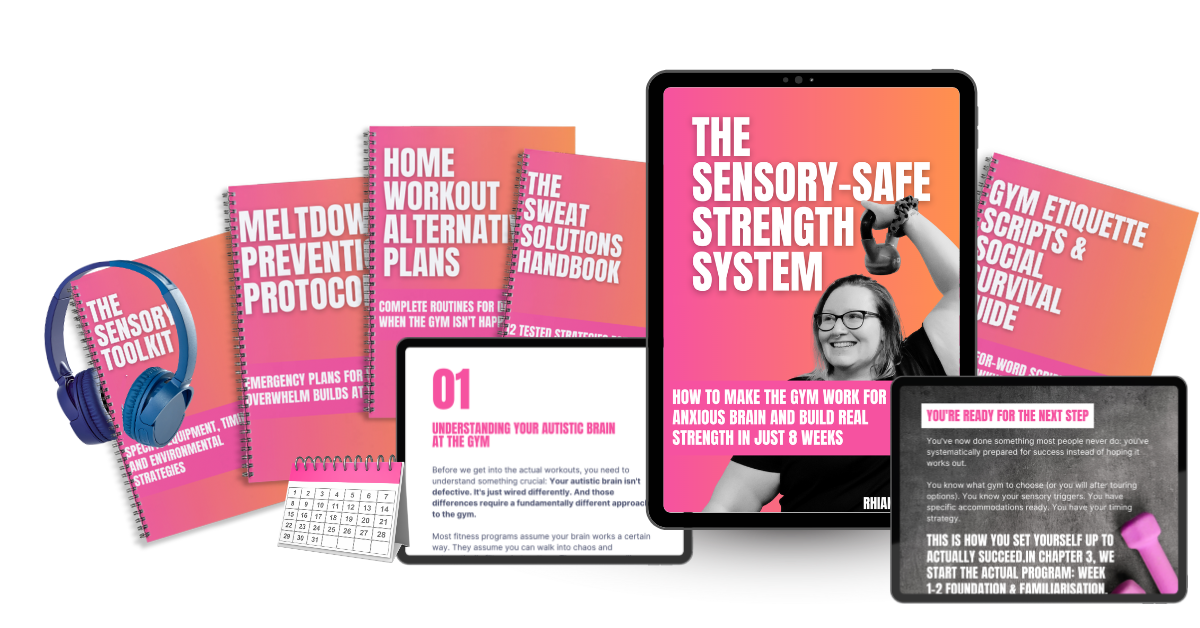
What you get:
8 weeks of progressive workouts with clear video demonstrations (no guessing about form)
Sensory survival strategies for every common gym scenario
Alternative exercises for when standard movements feel overwhelming
Zero-decision workout days designed for executive disfunction
Interoception guidance for recognising fatigue vs. sensory overload vs. actual pain
Lifetime access including all future updates
What You Get in the Sensory-Safe Strength System:
- 8 weeks of progressive workouts with clear instructions (no guessing about form)
- Sensory survival strategies for every common gym scenario
- Alternative exercises for when standard movements feel overwhelming
- Zero-decision workout days designed for executive dysfunction
- Interoception guidance for recognising fatigue vs. sensory overload vs. actual pain
- Lifetime access including all future updates
Usually £127. Currently £27.
Overcome Gym Anxiety with the Gym Confidence Starter Package
If sensory issues are part of a bigger picture of gym anxiety, the Gym Confidence Starter Package (£349) walks you through:
- Choosing a sensory-friendly gym that matches your needs
- Handling your first visit without overwhelm
- Managing social situations with word-for-word scripts
- Navigating sensory challenges in real time
- Building sustainable workout routines that actually stick
Start with Free Gym Anxiety Resources
Start with my free guide to overcoming gym anxiety. You'll learn the 5 real barriers that cause gym anxiety (sensory overload is one of them) plus practical strategies you can use immediately.
Sensory-Friendly Workout FAQs
Still have questions about working out with sensory sensitivities? Here are answers to the most common questions I get from neurodivergent clients:
Can I build strength with just bodyweight exercises and resistance bands?
Yes. You can build significant strength with bodyweight exercises and resistance bands, especially when you're starting out. Progressive overload (gradually increasing difficulty) works regardless of equipment. The key is consistency, which is much easier when you're not fighting sensory overload every session.
Is it okay to always work out at home instead of going to a gym?
Absolutely. Home workouts are just as valid as gym workouts. If the gym environment causes sensory overload that prevents you from exercising consistently, working out at home is the smarter choice. You can always transition to a gym later if you want to, but there's no requirement to do so.
What if I can only manage 10-15 minutes of exercise before getting overwhelmed?
Then do 10-15 minutes. Shorter, consistent workouts are more effective than longer sessions you can't sustain. You can gradually increase duration as your nervous system adapts, or you can stick with shorter sessions indefinitely; both approaches work.
Are noise-canceling headphones really necessary, or am I just being too sensitive?
If unpredictable gym sounds derail your workout, noise-canceling headphones aren't a luxury, they're a practical tool that removes a barrier. You're not "too sensitive"; you're responding normally to genuinely overwhelming stimuli. Using headphones is a reasonable accommodation, not a character flaw.
How do I know if I'm experiencing sensory overload or just normal workout discomfort?
Normal workout discomfort is localised to specific muscles and feels like effort or fatigue. Sensory overload affects your whole nervous system, irritability, difficulty concentrating, feeling "buzzy" or on edge, increased sensitivity to sounds or lights, or wanting to escape the environment entirely. They feel fundamentally different once you learn to distinguish them.
What's the quietest time to go to the gym?
Gyms are typically quietest during mid-morning (10am-12pm) on weekdays, or late evening (after 8pm) depending on your gym's closing time. Avoid lunch hours (12pm-2pm), after-work rush (5pm-7pm), and weekend mornings. Check my guide to finding quiet gym times for more detailed strategies.
More Resources for Sensory-Friendly Fitness
Free Guides & Articles:
- Finding Quiet Gym Times – Strategic timing can transform your gym experience from overwhelming to manageable.
- The Ultimate Guide to Neurodivergent Fitness – Everything you need to know about fitness when you're autistic or have ADHD.
- The Truth About Gym Clothing – How to choose gym clothes that work with sensory sensitivities.
- Gymtimidation Is Real – Why gym anxiety happens and what actually helps.
Paid Programs & Resources:
- Sensory-Safe Strength System (£27) – 8-week progressive program with sensory modifications built in.
- Bodyweight Exercises Guide (£9) – Start at home with zero equipment.
- Gym Confidence Starter Package (£349) – Complete support for your first gym experience.
