
Executive Function & Fitness: Resources for a Routine That Sticks
If you're looking for resources to build a fitness routine that works with executive function challenges, not against them, you're in the right place. The strategies below remove the barriers that traditional fitness advice ignores, and point you to structured tools that do the executive function work for you. You don't need more willpower. You need a routine designed for a brain where the project manager is overloaded.
You know what you're supposed to do. Wake up, put on gym clothes, drive to the gym, work out for 30 minutes, come home. Simple, right?
Except it's not.
Because somewhere between thinking "I should work out" and actually working out, your brain throws up a thousand tiny barriers. You can't find your gym bag. You forgot your headphones. You're not sure what exercises to do when you get there. The transition from work to gym feels insurmountable. And suddenly it's 8pm and you're on the sofa wondering why you "can't just do it."
If this sounds familiar, you're not broken. Your executive function is struggling, and everything you've been told about fitness ignores that reality entirely.
What No One Tells You About Exercise and Executive Dysfunction
Traditional fitness advice assumes your brain's project manager is fully functional. It assumes you can:
Initiate tasks when you plan to
Remember what you need without visual reminders
Transition smoothly between activities
Make decisions without getting overwhelmed
Maintain routines without external structure
But if you're neurodivergent, or dealing with depression, burnout, chronic illness, or any condition that impacts executive function; your brain's project manager is understaffed, overworked, and possibly on fire.
The result? You want to exercise. You genuinely want to. But wanting isn't enough when every micro-step requires executive function you simply don't have.
Barriers That Fitness Advice Never Addresses
It's not that you're not motivated. It's that getting changed requires task initiation, and your brain can't generate the activation energy to start.
It's not that you're lazy. It's that you can't remember where your gym shoes are, your water bottle is dirty, and you've run out of clean workout clothes, and gathering these scattered items requires working memory and planning you don't have available.
It's not that you don't care. It's that the transition from work to gym feels like climbing Everest, and once you're there, the decision fatigue of choosing exercises shuts your brain down completely.
These aren't character flaws. They're executive function challenges. And they need executive function solutions.
This is exactly why I created the Movement Menu; a monthly membership that makes the decision for you.
Rate your energy, tell it where you are, and it gives you one workout. That's it. No thinking required.
Strategy 1: Stop Making Your Future Self Get Dressed
Here's what happens in a typical morning: alarm goes off, you need to get out of bed, find workout clothes, convince yourself to put them on, then leave the house.
That's four separate executive function demands before you even start exercising.
Try this instead: Sleep in your workout clothes. Or put them on the floor right where you'll step when you get out of bed.
I know it sounds ridiculous. But eliminating that "get changed" barrier removes one entire task initiation point. You're already dressed. One fewer decision. One fewer barrier.
Pick comfortable gym clothing that works as loungewear; think soft joggers and a hoodie, not restrictive leggings. If you're sensory-sensitive, choose seamless options with no tags.
The goal isn't to look gym-ready. It's to remove barriers between you and movement.
Strategy 2: The Backup Plan That Actually Works
Here's where most people mess up: they create elaborate workout plans, then feel like failures when they can't execute them.
All-or-nothing thinking is executive dysfunction's best friend. Miss your "proper" workout and you'll probably abandon exercise entirely, at least until the next wave of motivation hits.
Try this instead: Create a "stupid simple" backup workout that always counts as completing your exercise goal.
Your backup options:
Five wall push-ups
Walk to the end of your street
Ten bodyweight squats
Dance to one song
Three minutes of stretching
The critical rule: It counts.
Don't diminish it. Don't say "it's not a real workout." You moved your body intentionally. That's the goal.
One of my clients has "5 wall push-ups" as his backup. Some days that's literally all he does. But he's worked out 47 days in a row because even his worst days count. Before this rule, missing a "real" workout meant he'd quit for weeks.
Consistency matters more than intensity. Always.
Plus, you can exercise at home in your own sensory-safe space with 80 bodyweight movements; I’ve made a guide for it!
Strategy 3: Stop Relying on Willpower (It's Not Reliable)
Internal motivation is lovely when it shows up. But executive dysfunction means willpower is inconsistent at best.
Try this instead: Create external accountability structures.
Body doubling is particularly effective. This means working out while another person is present, even virtually, even if they're doing something completely different.
Set up a FaceTime call with a friend. Join a Discord community with live workout sessions. Meet someone at the gym even if you do different workouts. Just presence, no commentary, no comparison, makes task initiation significantly easier.
Or schedule actual appointments: personal training sessions, group classes, or calendar blocks you treat as non-negotiable meetings.
The structure comes from outside your brain, which means it works even when your internal project manager has completely checked out.
Strategy 4: The One-Bag System That Eliminates Chaos
How many times have you skipped the gym because you couldn't find your headphones? Or your water bottle? Or clean socks?
Every item you need to remember depletes executive function before you even leave the house.
Try this instead: One gym bag. Permanently packed. Lives in one specific location. Never gets fully unpacked.
Pack duplicates of everything:
Complete workout outfit (plus backup)
Multiple pairs of socks and underwear
Headphones AND backup earbuds
Water bottle
Gym membership card attached to bag zipper
Deodorant, body wipes, dry shampoo
Any sensory tools you need (earplugs, sunglasses, fidgets)
Emergency snacks
The bag has one home, by your front door, in your car boot, in a specific closet. Not "usually by the door." Always in the exact same spot.
After the gym: remove dirty clothes, immediately add fresh ones, return bag to its spot. No waiting. No "I'll do it later."
One client keeps his gym bag in his car boot and it never comes inside. After the gym, he grabs clean clothes from a drawer in the garage and drives away. Simple. But before this system, he'd "forget" something every time and use it as an excuse not to go.
Strategy 5: Make Your Environment Do the Remembering
Working memory isn't reliable. Visual cues are.
Try this instead: Create visual reminder chains where each action automatically triggers the next.
Morning workout cascade:
Alarm → see workout clothes laid on floor
Put on clothes → see gym bag by door
Pick up bag → see car keys attached
Get in car → gym card already in cupholder
Arrive at gym → locker number written on your hand
Set up the entire chain the night before. Each object must be visually obvious, placed in exact sequence.
One client uses a bright orange cone that blocks her front door on gym days. She literally cannot leave without moving it. And when she moves it, she sees her gym bag hanging right behind it. Obnoxious? Yes. Effective? Absolutely.
Strategy 6: Stop Rushing Between Everything
Transitions are executive function black holes.
Going from work → gym → home requires massive mental energy to "switch gears." If you try to rush through transitions, you'll either skip the gym entirely or arrive so frazzled that actually working out becomes impossible.
Try this instead: Build in mandatory 10-15 minute buffer zones before and after workouts where you do nothing productive—just decompress.
Before the gym: Sit in your car. Listen to one full song. Scroll your phone for exactly 5 minutes. Eat a transition snack. Stare out the window and do absolutely nothing.
After the gym: Same thing. Decompress. Change clothes slowly. Don't immediately start driving or planning your evening.
This isn't wasted time—it's essential support that makes the workout actually happen.
For a 30-minute workout, block 90 minutes total:
15 minutes: Transition/leaving house
10 minutes: Driving/parking
10 minutes: Getting settled + buffer
30 minutes: Actual workout
10 minutes: Cool down
15 minutes: Post-workout buffer
When you're not rushed, executive function works better. The "extra" time isn't wasted—it's invested.
Strategy 7: Double Your Time Estimates for Everything
You think you need 45 minutes to fit in a 30-minute workout. You're wrong, you need 90 minutes. This is time blindness: executive dysfunction makes it genuinely hard to feel how long things take, so you consistently under-plan and then run late. And constantly running late triggers stress responses that further impair executive function.
Strategy 8: Give Your ADHD Brain the Novelty It Craves
ADHD brains need novelty. When routines become boring, motivation evaporates entirely—even if the routine was working.
But complete chaos increases cognitive load. You need structured novelty.
Try this instead: Keep the framework the same (time, location, duration), but rotate what changes (exercises, equipment, workout style, music).
Examples:
By day: Monday = strength, Wednesday = new class, Friday = cardio with new playlist
By week: Week 1 = upper body, Week 2 = lower body, Week 3 = circuits, Week 4 = whatever sounds fun
By equipment: Week 1 = dumbbells only, Week 2 = machines, Week 3 = bodyweight, Week 4 = bands
One client does "Adventure Workouts" on Fridays—his day to try whatever sounds interesting. Monday and Wednesday are structured. This balance keeps him going without boredom or chaos.
Strategy 9: Never Show Up Without a Plan
Decision fatigue at the gym leads to wandering aimlessly, feeling overwhelmed, and leaving without actually working out.
Try this instead: Pre-decide everything before you arrive.
Beginner version:
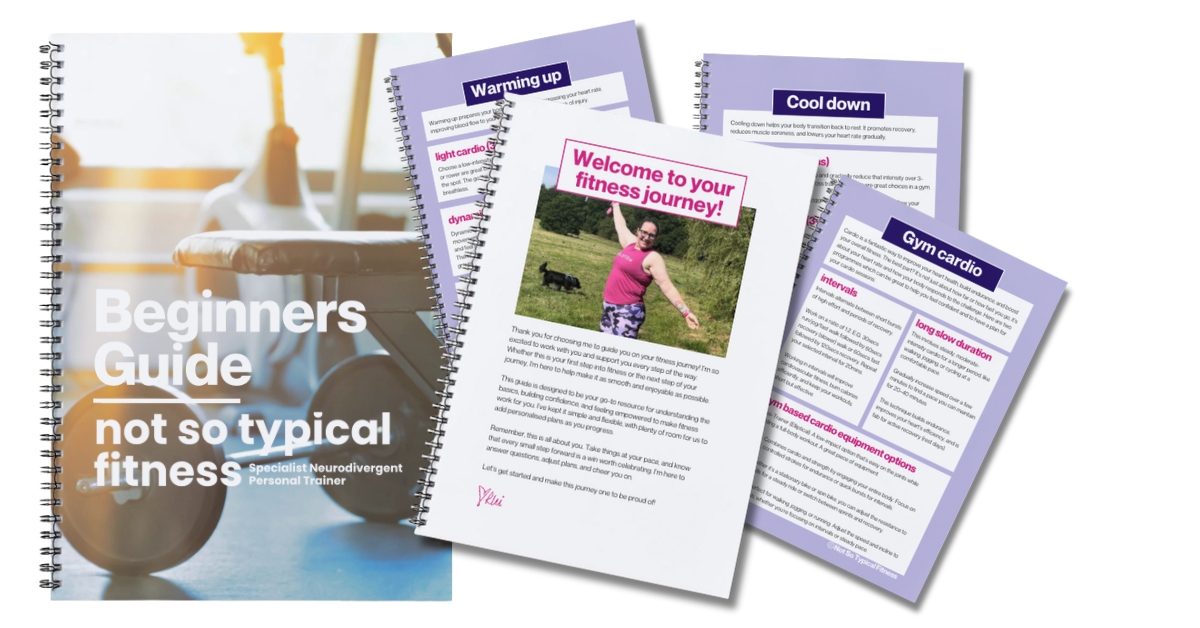
Same 3-5 exercises, same order, every single time. Only increase weight when current weight feels very easy. Check out the gym basics beginners guide for exercise ideas.
Intermediate version: Write down your exact workout the night before. Know which equipment you'll use and have backup exercises if equipment is busy. Screenshot it on your phone.
Advanced version: Follow a structured programme from an app or trainer that tells you exactly what to do each day.
Before leaving for the gym, you should know:
Exact exercises (by name)
Exact sets/reps
Exact equipment
Order of exercises
Backup options if equipment is busy
When you're done (exit criteria)
One client has 5 workout cards on index cards. On the way to the gym, she picks one without looking. That's her workout. No thinking, no optimising, no decision paralysis.
Strategy 10: Reward Yourself Today, Not Someday
"Eventually you'll see results" doesn't motivate ADHD brains. Future rewards feel abstract and unreal.
Try this instead: Immediate rewards after every single workout—rewards you get today.
The rules:
Immediate: Same day, ideally right after
Exclusive: Only happens after workouts
Consistent: Every workout gets rewarded, even backup workouts
Genuinely enjoyable: Must spark a dopamine hit
Free/low-cost options:
Specific post-workout snack you love
Fancy coffee shop visit (only after gym)
One episode of favourite show
20 minutes of guilt-free scrolling
Shower with expensive nice products
Workout sticker on tracking sheet
One client gets a £4 iced coffee after every workout. That's £160/month if he works out 4x/week. But it works because he literally thinks "I want coffee, so I need to work out first." It's the only thing that's made him consistent.
Don't wait for intrinsic motivation, start with external rewards now.
Build the habit. If intrinsic motivation shows up later, great. If not, keep the rewards forever.
Building Your Personal System
You don't need all these strategies. You need the right combination for your specific barriers.
If your main barrier is starting: → Already Dressed Method + One-Bag System + Realistic Time Blocking
If your main barrier is transitions: → Buffer Zones + Visual Cues + External Accountability
If your main barrier is boredom: → Novelty Rotation + Reward Immediacy + Backup Plans
If your main barrier is decision fatigue: → No Decisions Protocol + One-Bag System + Backup Plans
Start with ONE strategy. Implement it consistently for two weeks. Then evaluate and add more only if needed.
Three strategies is enough for most people.
When Strategies Aren't Enough
Sometimes executive dysfunction is severe enough that self-directed strategies don't cut it. That's not failure—it's important information.
Signs you need additional support:
You've tried multiple strategies for a month with no improvement
Executive dysfunction severely impacts multiple life areas
Mental health conditions are worsening
Sensory overwhelm is constant and unmanageable
You're not failing at fitness because you lack discipline. You're struggling because every piece of traditional fitness advice assumes functional executive function, and yours is compromised.
The solution isn't trying harder. It's removing barriers, adding external structure, and working with your brain instead of against it.
Pick one strategy. Try it for two weeks. See what happens.
Because the version of fitness that works for your brain probably looks nothing like the version you've been told you "should" do, and that's exactly as it should be.
Resources for executive-function-friendly fitness
Tools that remove the executive function load rather than add to it. Pick the one that matches where you're stuck.
-
The Movement Menu Monthly membership
Makes the decision for you. Rate your energy, tell it where you are, and it gives you one workout. No planning, no choosing, no decision fatigue.
Best for decision fatigue -
80 bodyweight exercises with step-by-step instructions. Work out at home in your own sensory-safe space; zero equipment, zero setup.
Best for getting started at home -
The Sensory-Safe Strength System Structured programme
Every decision pre-made, built for sensory sensitivities and executive dysfunction. Follow it; nothing to work out yourself.
Best for wanting a plan handed to you -
Online coaching 1:1 support
Personalised programming and external accountability, so the structure comes from outside your brain instead of your willpower.
Best for needing accountability
Frequently Asked Questions
Where can I find resources for building a fitness routine with executive function challenges?
Look for tools that remove decisions rather than add them: pre-planned programmes, decision-free workout apps like the Movement Menu, body-doubling communities, and personal trainers who build in executive function accommodations. The goal is external structure that works even when your internal motivation and planning capacity have run out.
How do I build a fitness routine when I have ADHD or executive dysfunction?
Start with one strategy, not a whole system. Remove the biggest barrier first, usually task initiation or decision fatigue, by pre-deciding your workout, reducing the steps between you and movement, and creating a "stupid simple" backup that always counts. Add external accountability, and reward yourself immediately after every session.
Why is it so hard to start exercising even when I want to?
Wanting to exercise and being able to initiate it are different things. Executive dysfunction means the micro-steps, getting changed, gathering your kit, switching from one activity to another, each require activation energy your brain struggles to generate. It's not a motivation or discipline problem; it's an executive function one, and it needs executive function solutions.
What's the easiest way to stay consistent with exercise if I'm neurodivergent?
Lower the bar until it's impossible to fail. A backup workout as small as five wall push-ups still counts, which keeps your streak alive on your worst days. Consistency comes from removing barriers and adding external structure, not from trying harder.
